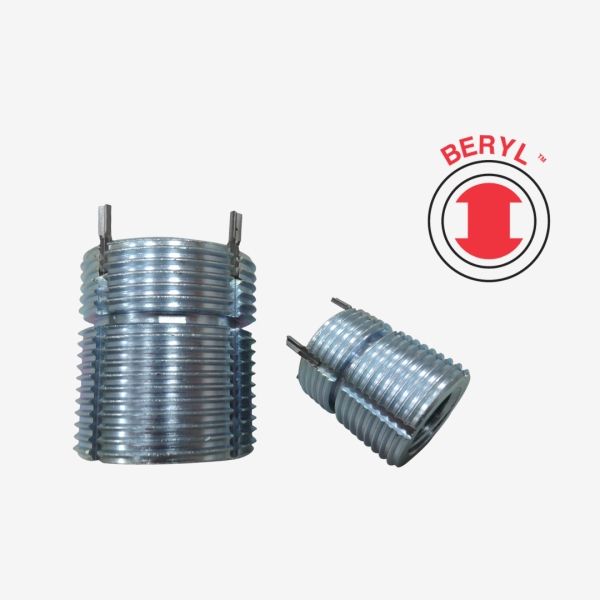

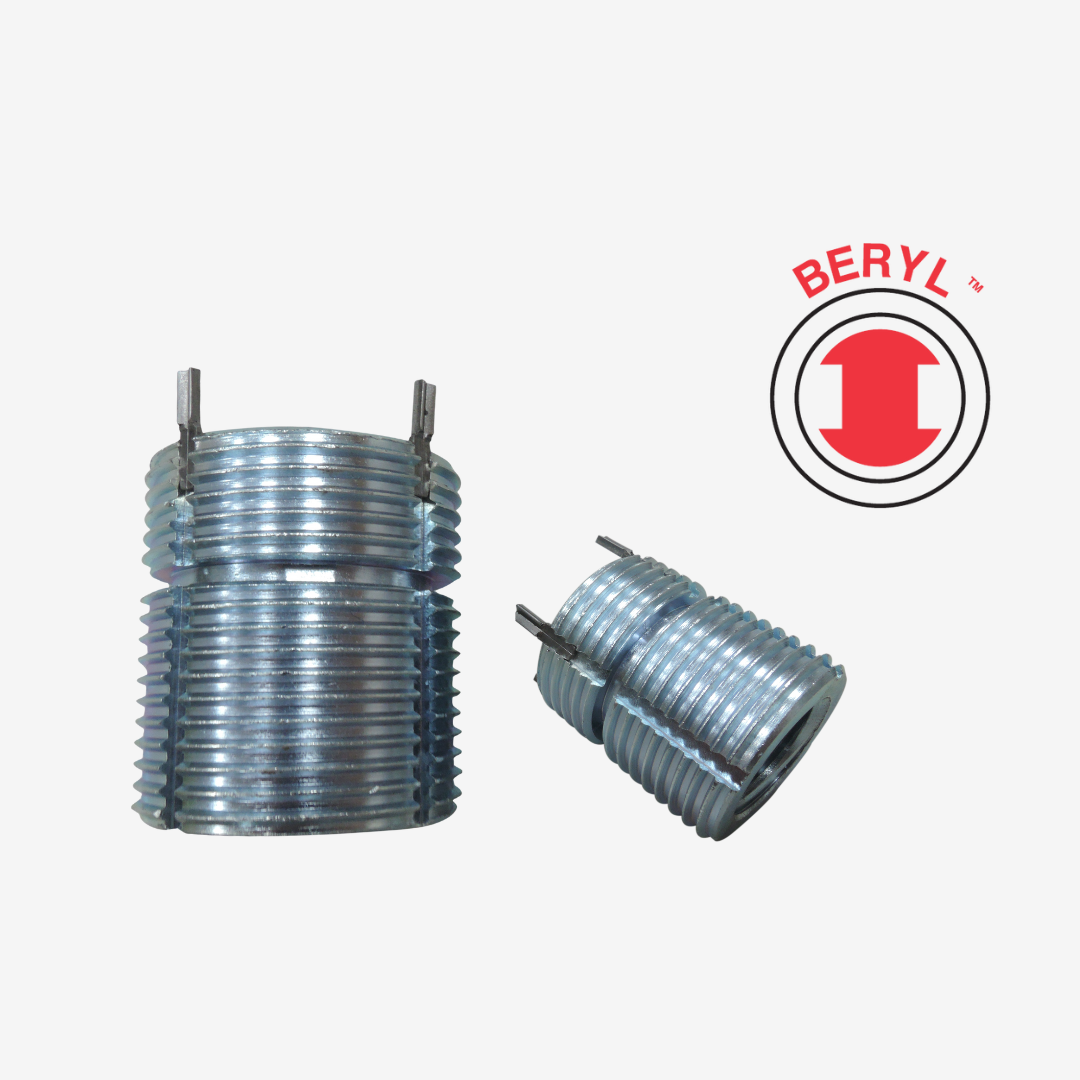
Description
Self-Locking Threaded Insert Sizes, Dimensions & Specifications
The tables below list standard heavy-duty and extra-heavy-duty self-locking threaded insert sizes, including internal thread size, external thread size, insert length, recommended drill size, tap size, drilling depth and number of locking keys. Select the required part number for your RFQ. Inch, metric and custom configurations may be available for OEM production.
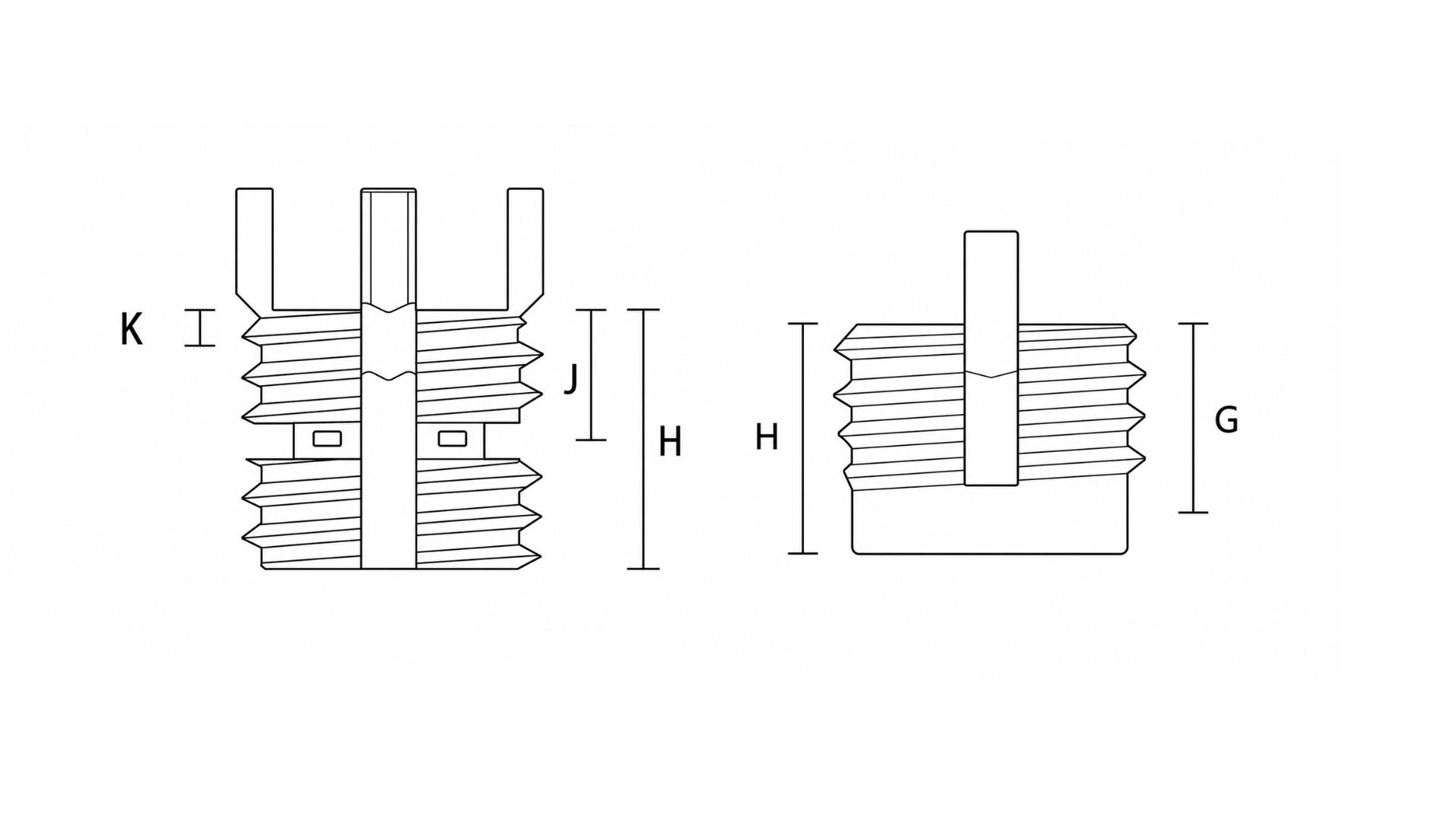
| Heavy Duty-inch | ||||||||
| Inserts | Installation | |||||||
| Internal thread | External thread(Mod.) | Length / L | J ±0.30 | C’bore depth K | Tap Drill Size | C’Sink DIA. +.010 -.000 | Thread tap | |
| Size | Min. depth | |||||||
| #8-32 | #5/16-18 | 0.312 | 0.22 | 0.04 | 0.272 | 0.323 | #5/16-18 | 0.37 |
| #10-24 | #3/8-16 | 0.312 | 0.22 | 0.07 | 0.332 | 0.385 | #3/8-16 | 0.37 |
| #10-32 | #3/8-16 | 0.312 | 0.22 | 0.07 | 0.332 | 0.385 | #3/8-16 | 0.37 |
| #1/4-20 | #7/16-14 | 0.375 | 0.22 | 0.07 | 0.397 | 0.447 | #7/16-14 | 0.43 |
| #1/4-28 | #7/16-14 | 0.375 | 0.22 | 0.07 | 0.397 | 0.447 | #7/16-14 | 0.43 |
| #5/16-18 | #1/2-13 | 0.437 | 0.22 | 0.07 | 0.453 | 0.51 | #1/2-13 | 0.5 |
| #5/16-24 | #1/2-13 | 0.437 | 0.22 | 0.07 | 0.453 | 0.51 | #1/2-13 | 0.5 |
| #3/8-16 | #9/16-12 | 0.5 | 0.25 | 0.07 | 0.516 | 0.572 | #9/16-12 | 0.56 |
| #3/8-24 | #9/16-12 | 0.5 | 0.25 | 0.07 | 0.516 | 0.572 | #9/16-12 | 0.56 |
| #7/16-14 | #5/8-11 | 0.625 | 0.28 | 0.1 | 0.578 | 0.635 | #5/8-11 | 0.68 |
| #7/16-20 | #5/8-11 | 0.625 | 0.28 | 0.1 | 0.578 | 0.635 | #5/8-11 | 0.68 |
| #1/2-13 | #11/16-11NS | 0.688 | 0.28 | 0.1 | 0.641 | 0.7 | #11/16-11NS | 0.75 |
| #1/2-20 | #11/16-11NS | 0.688 | 0.28 | 0.1 | 0.641 | 0.7 | #11/16-11NS | 0.75 |
| #9/16-12 | #13/16-16 | 0.812 | 0.32 | 0.1 | 0.766 | 0.822 | #13/16-16 | 0.94 |
| #9/16-18 | #13/16-16 | 0.812 | 0.32 | 0.1 | 0.766 | 0.822 | #13/16-16 | 0.94 |
| #5/8-11 | #7/8-14 | 0.875 | 0.33 | 0.1 | 0.828 | 0.885 | #7/8-14 | 1 |
| #5/8-18 | #7/8-14 | 0.875 | 0.33 | 0.1 | 0.828 | 0.885 | #7/8-14 | 1 |
| #3/4-10 | #1-1/8-12 | 1.125 | – | 0.1 | 1.062 | 1.145 | #1-1/8-12 | 1.31 |
| #3/4-16 | #1-1/8-12 | 1.125 | – | 0.1 | 1.062 | 1.145 | #1-1/8-12 | 1.31 |
| #3/4-10 | #1-1/8-12 | 1.25 | 0.49 | 0.1 | 1.062 | 1.145 | #1-1/8-12 | 1.44 |
| #3/4-16 | #1-1/8-12 | 1.25 | 0.49 | 0.1 | 1.062 | 1.145 | #1-1/8-12 | 1.44 |
| #7/8-9 | #1-1/4-12 | 1.125 | – | 0.1 | 1.187 | 1.27 | #1-1/4-12 | 1.44 |
| #7/8-14 | #1-1/4-12 | 1.125 | – | 0.1 | 1.187 | 1.27 | #1-1/4-13 | 1.44 |
| #7/8-9 | #1-1/4-12 | 1.375 | 0.49 | 0.1 | 1.187 | 1.27 | #1-1/4-14 | 1.56 |
| #7/8-14 | #1-1/4-12 | 1.375 | 0.49 | 0.1 | 1.187 | 1.27 | #1-1/4-15 | 1.56 |
| #1”-8 | #1-3/8-12 | 1.375 | – | 0.1 | 1.312 | 1.395 | #1-3/8-12 | 1.56 |
| #1”-12 | #1-3/8-12 | 1.375 | – | 0.1 | 1.312 | 1.395 | #1-3/8-12 | 1.56 |
| #1”-8 | #1-3/8-12 | 1.5 | 0.55 | 0.1 | 1.312 | 1.395 | #1-3/8-12 | 1.68 |
| #1”-12 | #1-3/8-12 | 1.5 | 0.55 | 0.1 | 1.312 | 1.395 | #1-3/8-12 | 1.68 |
What Is a Self-Locking Threaded Insert?
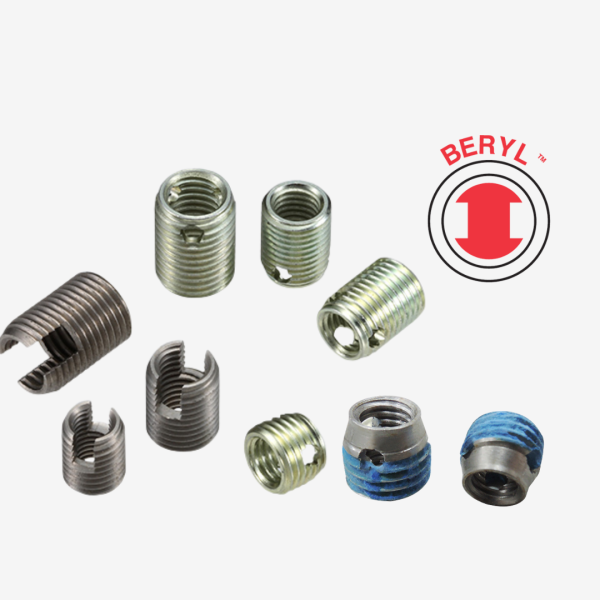
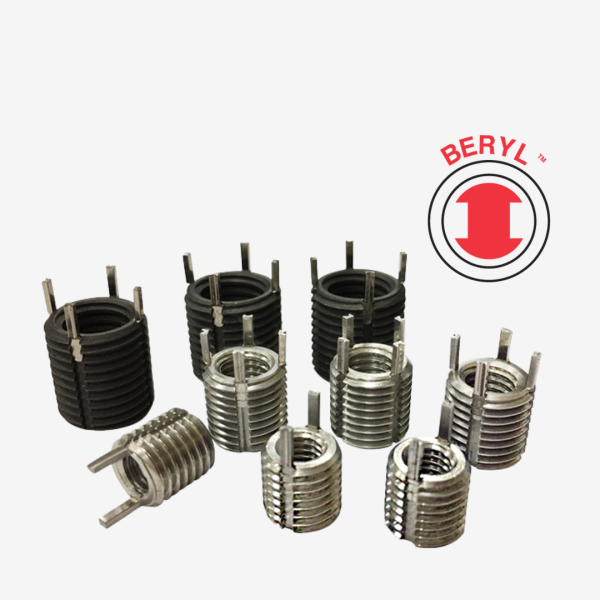
A self-locking threaded insert is a solid threaded insert designed to create a strong, reusable internal thread while helping resist loosening of the installed bolt or screw.
This product combines two separate locking functions:
- The external locking keys mechanically secure the insert body to the parent material.
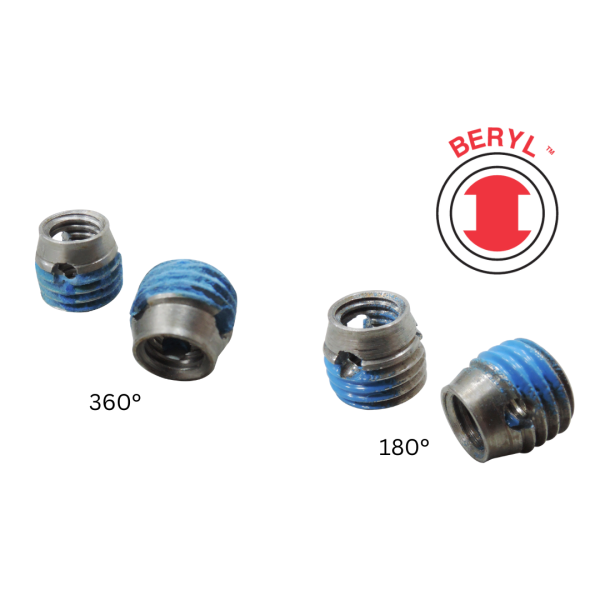
- The internal self-locking feature applies controlled resistance to the mating bolt, helping reduce loosening caused by vibration or repeated loading.
Self-locking threaded inserts may also be searched for as:
- Self-locking key inserts
- Self-locking key locking inserts
- Internally locking threaded inserts
- Vibration-resistant threaded inserts
- Locking thread repair inserts
- Heavy-duty locking inserts
- Keysert-style self-locking inserts
They are used in new equipment and thread-repair applications where both insert retention and mating-bolt retention are important.
How the Two Locking Features Work
The locking keys and internal thread lock perform different functions.
External locking keys are driven into the parent material after the insert is threaded into the prepared hole. These keys help prevent the insert body from rotating or backing out.
The internal locking feature creates resistance between the insert and the mating bolt. This helps reduce bolt loosening in assemblies exposed to vibration, shock or repeated loading.
The internal locking feature does not replace correct bolt selection, tightening torque or joint design. Final performance depends on the insert configuration, mating fastener, installation and application conditions.
Heavy-Duty Self-Locking Inserts
Heavy-duty self-locking inserts provide a strong internal thread while maintaining a practical external thread diameter for many machinery and equipment applications.
They are commonly used for:
- Reinforcing threads in aluminum and other softer metals
- Repairing stripped or damaged threaded holes
- Components exposed to vibration
- Repeated bolt installation and removal
- Industrial machinery and equipment
- Automotive and transportation assemblies
- OEM-manufactured components
Refer to the specification chart for the required internal thread, external thread, insert length, drill size and installation depth.
Extra-Heavy-Duty Self-Locking Inserts
Extra-heavy-duty self-locking inserts have a larger body and thicker wall for applications requiring greater strength and more parent-material engagement.
They may be selected when:
- Higher loads are expected.
- Greater pull-out strength is required.
- The original mounting hole is badly damaged or oversized.
- Sufficient parent material is available around the hole.
- The assembly is exposed to severe vibration or repeated loading.
- A larger external thread can be accommodated.
Before selecting an extra-heavy-duty insert, confirm the available wall thickness, edge distance, hole depth and surrounding material.
Inch and Metric Thread Options
Self-locking threaded inserts are available in standard inch and metric thread configurations.
Available options may include:
- UNC coarse threads
- UNF fine threads
- Standard metric coarse threads
- Selected metric fine threads
- Heavy-duty configurations
- Extra-heavy-duty configurations
- Miniature and lightweight styles
- Special internal and external thread combinations
The internal thread determines the mating bolt size. The external thread determines the required tapped mounting hole.
Refer to the specification tables for the exact relationship between internal thread, external thread, drill size, insert length and drilling depth.
Materials & Finishes
Self-locking threaded inserts are available in steel, stainless steel and alloy steel.
Steel self-locking inserts provide economical strength for general industrial machinery, production equipment and repair applications.
Stainless steel self-locking inserts provide improved corrosion resistance and may be selected for outdoor equipment, moisture exposure and applications requiring stainless material compatibility.
Alloy steel self-locking inserts may be used for demanding applications requiring higher strength or specific mechanical properties.
Material and finish selection should consider:
- Required strength
- Parent material
- Corrosion exposure
- Operating temperature
- Environmental requirements
- Galvanic compatibility
- Mating fastener material
- Applicable industry specifications
Custom finishes may be available depending on insert size, material and production quantity.
Self-Locking Inserts for Aluminum
Aluminum components are a common application for self-locking threaded inserts.
Repeated installation and removal of a steel bolt can wear or damage threads formed directly in aluminum. A steel or stainless steel insert provides a stronger and more durable internal thread.
The self-locking feature is particularly useful when the assembly is also exposed to vibration or repeated movement.
Common aluminum applications include:
- Aluminum castings
- Engine and gearbox housings
- Aerospace components
- Machine housings
- Tooling plates
- Fixtures
- Electronic equipment
- Robotic and automated machinery
The parent material must have sufficient thickness and edge distance for the insert’s external thread and locking keys.
How to Install a Self-Locking Key Insert
Self-locking key inserts are installed using standard drilling and tapping operations followed by a key-driving step.
General installation procedure:
- Drill the mounting hole to the recommended diameter.
- Countersink the opening if required by the installation specification.
- Tap the hole using the specified external thread size.
- Thread the insert into the prepared hole.
- Seat the insert to the recommended position.
- Place the correct installation tool over the insert.
- Drive the locking keys into the parent material.
- Confirm that the keys are fully seated.
- Install the mating bolt using the specified torque.
The locking keys secure the insert body. The internal locking feature engages the mating bolt when the bolt reaches the locking section of the internal thread.
Always follow the size chart for the correct drill, tap, depth and installation-tool requirements.
Self-Locking vs. Standard Key Locking Inserts
Both products use external locking keys to secure the insert body in the parent material.
A standard key locking insert provides a free-running internal thread. It reinforces or repairs the threaded hole, but it does not intentionally apply a locking force to the mating bolt.
A self-locking key insert includes an internal locking feature that helps resist mating-bolt loosening under vibration.
Choose a standard key locking insert when:
- Free-running bolt installation is required.
- The bolt is secured using another locking method.
- Thread repair or reinforcement is the primary requirement.
- Lower installation and removal torque is preferred.
Choose a self-locking insert when:
- The assembly is exposed to vibration or shock.
- Additional resistance to bolt loosening is required.
- The bolt may be installed and removed during maintenance.
- Loose locking hardware is undesirable.
- The application requires both thread reinforcement and bolt retention.
Self-Locking Threaded Insert vs. Locking Adhesive
Thread-locking adhesive is applied to the mating threads during assembly. Its performance can depend on surface condition, application amount, cure time, temperature and chemical exposure.
A self-locking insert provides a mechanical locking feature built into the component. This can simplify repeat assembly and reduce reliance on separately applied locking compounds.
However, the best option depends on:
- Required locking torque
- Number of installation cycles
- Operating temperature
- Chemical exposure
- Maintenance requirements
- Applicable engineering specifications
The customer’s engineering team should confirm the required locking method for the final assembly.
Typical Applications
Self-locking threaded inserts are commonly used in:
- Aerospace hardware
- Automotive components
- Transportation equipment
- Engines and gearbox housings
- Industrial machinery
- Pumps and valves
- Robotics and automation systems
- Electronic equipment housings
- Tooling and fixtures
- Aluminum and magnesium castings
- High-vibration equipment
- Maintenance and repair operations
- Reusable access and service points
- OEM production assemblies
How to Select the Correct Insert
When requesting a quote, provide:
- Required internal thread size
- Inch or metric thread
- Heavy-duty or extra-heavy-duty style
- Parent material
- Available wall thickness
- Installation-hole depth
- Insert material
- Required finish
- Locking-performance requirement
- Mating bolt material and grade
- Expected installation cycles
- Required quantity
- Drawing or applicable specification
If replacing an existing insert, provide the existing part number, sample or dimensional drawing.
Factory-Direct Supply & Custom Options
Imperial Rivets & Fasteners supplies factory-direct self-locking threaded inserts for industrial distributors, equipment manufacturers, repair facilities and OEM production programs.
Available options may include:
- Inch and metric threads
- Heavy-duty and extra-heavy-duty bodies
- Steel, stainless steel and alloy steel
- Coarse and fine thread pitches
- Two-key and four-key configurations
- Miniature and lightweight inserts
- Special internal and external thread combinations
- Custom materials and finishes
- Components manufactured to drawings
- Installation tools
- Production-volume packaging
Select an available size from the specification chart and add it to your RFQ. If the required configuration is not listed, send our sales team your drawing, thread requirements or sample for review.
What if my required size is not listed?
Send us the internal thread, external thread limitation, parent material, quantity and drawing. Custom or special configurations may be available.
Questions or Custom Requirements?
Contact our sales team at sales@imperialrivet.com or (630) 964-0208.